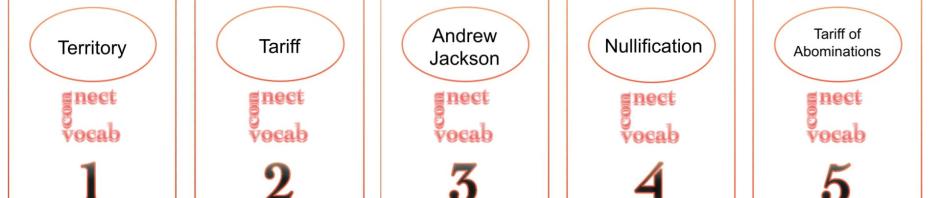
This post describes the design and evolution of Vocab Connect, a card-based vocabulary game built to get students talking through academic language. Inspired by the table-talk of Apples to Apples and grounded in tiered vocabulary, the game rewards students for making and defending increasingly complex connections out loud. This post highlights how the game has lasted nearly a decade in my classroom and how a recent redesign finally made it easy to build and share new decks.
Back in 2015, I purchased a new copy of Apples to Apples. Prior to teaching when I managed AmeriCorps teams, that was my favorite lunchtime activity. We played these epic games where the competition was fierce.
But my favorite part wasn’t the winning – it was the table talk. I love table talk.
Making the case that your card fits best. Convincing others. Occasionally downplaying your own card when you were winning too much. Table talk just makes games better! I was excited to revisit one of my favorite party games.
The social element stuck with me.
In the fall of 2015, I felt like I could breathe again after completing my Masters program. No more constant deadlines. No more coursework for a bit. It was a bit freeing and my mind had space to wander.
It was during this time that I had the idea for a card-based vocabulary game that incorporated the table-talk element of Apples to Apples. I wanted a review game that got students talking about vocabulary – making and defending connections between words. Around the same time, we had just done professional development on tiered vocabulary. This gave me the idea to tier the vocabulary for the game – opting for numbering the cards based upon complexity 1 – 5.
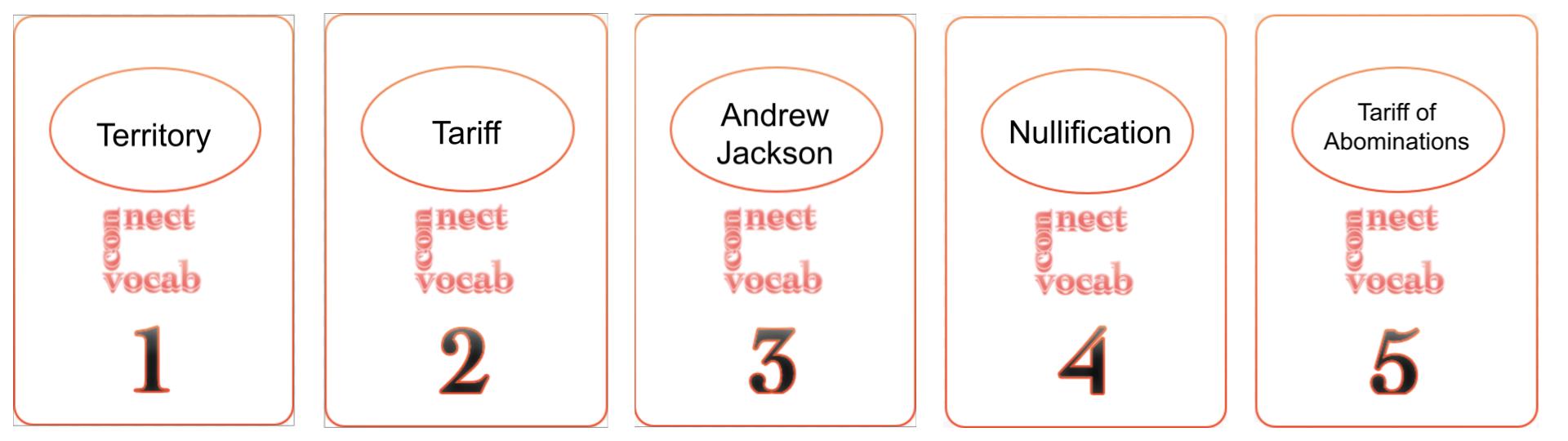
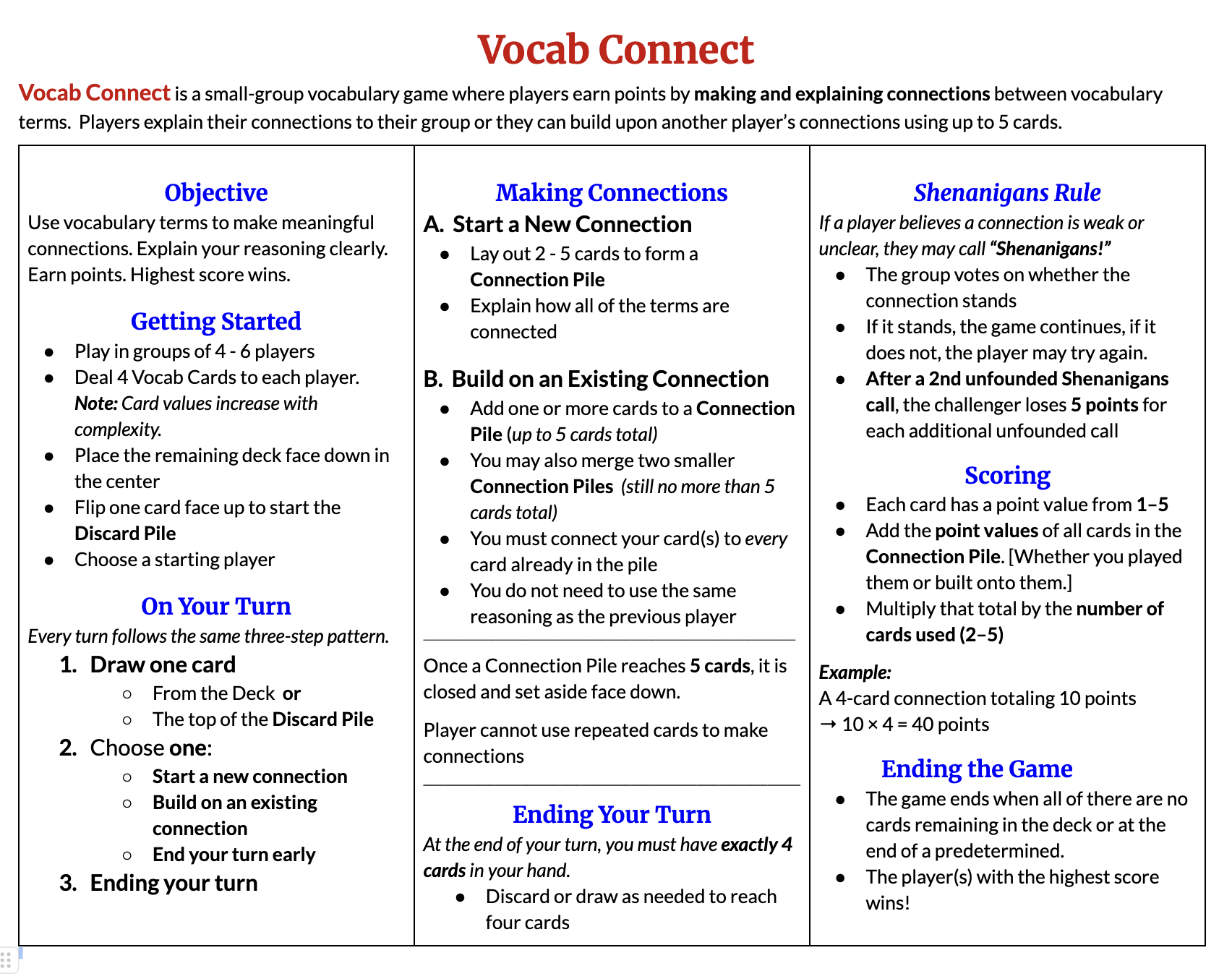
At its core, the game is a bit of the social element of Apples to Apples mixed with the card game Rummy. After being dealt a hand of cards, students lay down 2-5 cards to start their own connection piles or build onto the piles of their opponents. The bigger and more complex the connection, the more points it’s worth. A connection pile can grow to a maximum of five cards – anything more than that became unwieldy during early playtesting.
Scoring reinforces the same idea: add up the point values of all of the cards in a connection, then multiply that total by the number of cards used. Bigger, more thoughtful connections are rewarded.
But the most important rule has always been this:
You must make your connection audibly.
Every play requires an explanation to the group. Then the next player can build on that connection – or start a new one – but they also have to explain. I’ve found that students who are shaky on certain vocabulary words start to pick them up naturally as they hear classmates use them repeatedly and in context.
Sometimes students ask if they can use their notebooks while playing. Why not? The goal isn’t to stump students; it’s to get them playing with the vocabulary. If checking notes or receiving a well-timed hint keeps the game moving and the language circulating, that’s a feature, not a bug. This is especially true for some of the rarer 5-point words, which can be very specific.
When we play, students will often run through two rounds, and we sometimes highlight particularly high scores at the end. That little bit of recognition adds to the energy, but doesn’t overshadow the real point of the game: sustained, social engagement with academic language.
Vocab Connect has consistently landed especially well with freshmen. My Juniors have also gotten into it, but freshmen tend to get competitive in the best way. I usually run four to five decks per class, with four to six students per group being the sweet spot (though you technically could probably play with two).
I playtested early versions of the game with a few students back in February 2016 (10 years ago!) to work out the bugs. Limiting connection piles to five cards came directly out of that testing. The scoring system evolved the same way.
A year later, I had to add the “Shenanigans rule”. If a connection felt questionable, another player could challenge it by calling “Shenanigans,” and the group would vote on whether the connection stood. That worked well – until one class decided to challenge everything. They wanted to rename the game “Shenanigans.” I was mildly amused, but it slowed down gameplay. I added a follow-up rule: after a second unfounded “Shenanigans” call, the challenger loses points. The class did understand the need for the rule, and I jokingly referred to it as the Period 2 Rule for the rest of the year.
Vocab Connect has been a mainstay in my classroom since 2016. I even got lucky one year when my department head walked in for an observation and caught the game in progress – high engagement, constant academic language, students arguing (politely) about vocabulary. It was one of those rare moments where the timing just worked. Check, check, and check.
I always wanted to share it with others, but I couldn’t.
The game was fun and engaging but the setup was a pain!
Originally, the cards lived as Google Drawings embedded in Google Docs. Editing a deck meant clicking into each drawing individually and typing in the terms. I had already made decks for several units, so reusing them myself was easy. Creating new ones – or sharing the game with others – was not.
Recently, with some unexpected free time on a snow day, I finally fixed that part.
The game hasn’t changed. The cards are the same – they’re just housed in Google Slides now, which removes a very annoying extra part of setup. That was only Step One. I also created a Google Sheet where you can enter the terms once and automatically generate a full deck. The Sheet uses an embedded Apps Script that, once connected to the Slides template, creates a new file with all of your cards populated. You might still need to tweak spacing here or there, but this saves a huge amount of time.
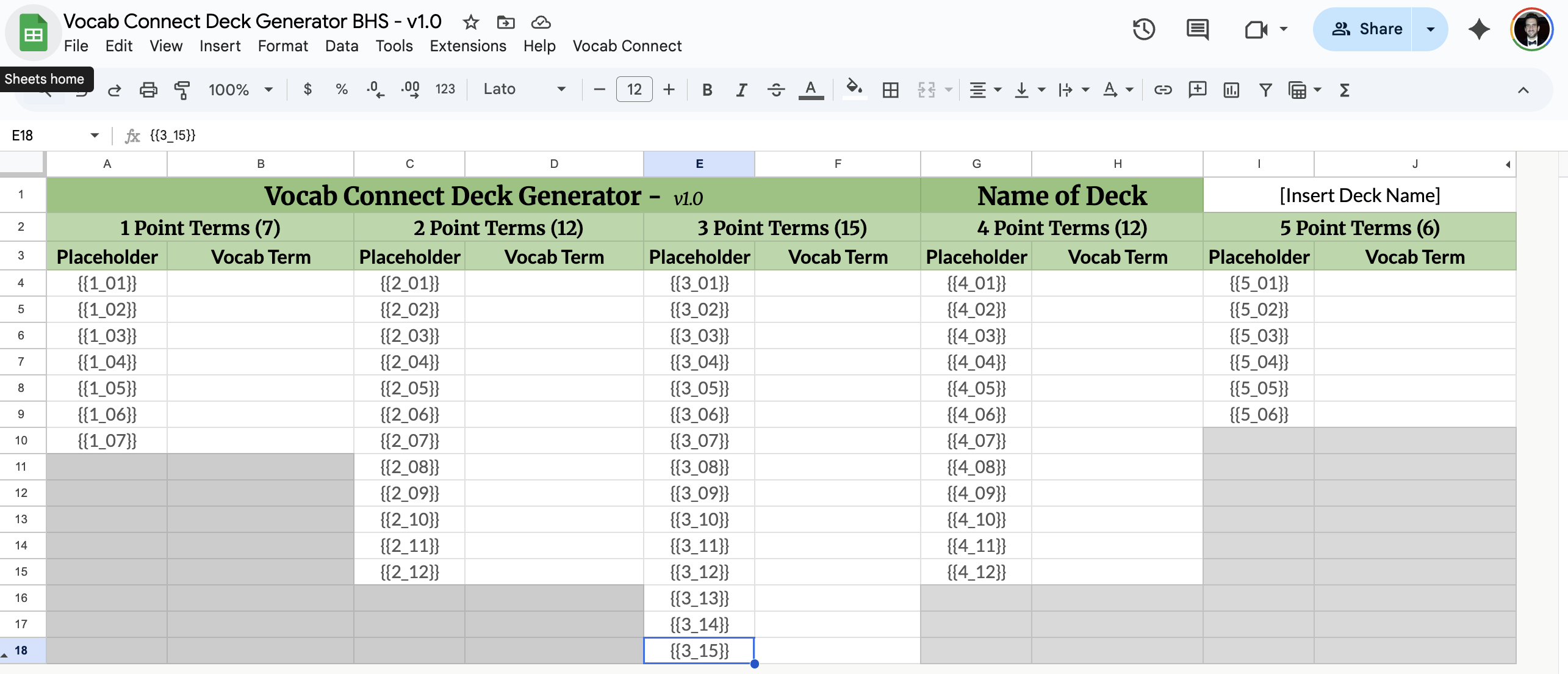
I’m genuinely excited about this update – not because the game changed, but because it finally feels easy to build decks and share. If you’re interested in trying it, the links and one-page setup guide are below.
Cheers!
Links & Resources
If you are interested in taking Vocab Connect for a spin – here are the links!
- Vocab Connect Game Rules
- Quick One Page Automation Setup Guide
- Vocab Connect Deck Generator– the Google Sheet
- Vocab Connect Deck Template – the Google Slide
A Possible Variant: Community Cards
One last thought, for anyone who enjoys tinkering with game formats.
While driving into work last week, I started mentally plotting out a Texas Hold’em–style version of the game. I haven’t tested it in class yet, but on paper it feels promising.
In this version, players are dealt three cards while a shared set of community cards is revealed in stages. After each reveal, players can make small adjustments to their hand before ultimately using a combination of their own cards and the community cards to build a connection. Scoring works the same way – based on point values and the number of cards used – and, as always, players must explain their connections out loud.
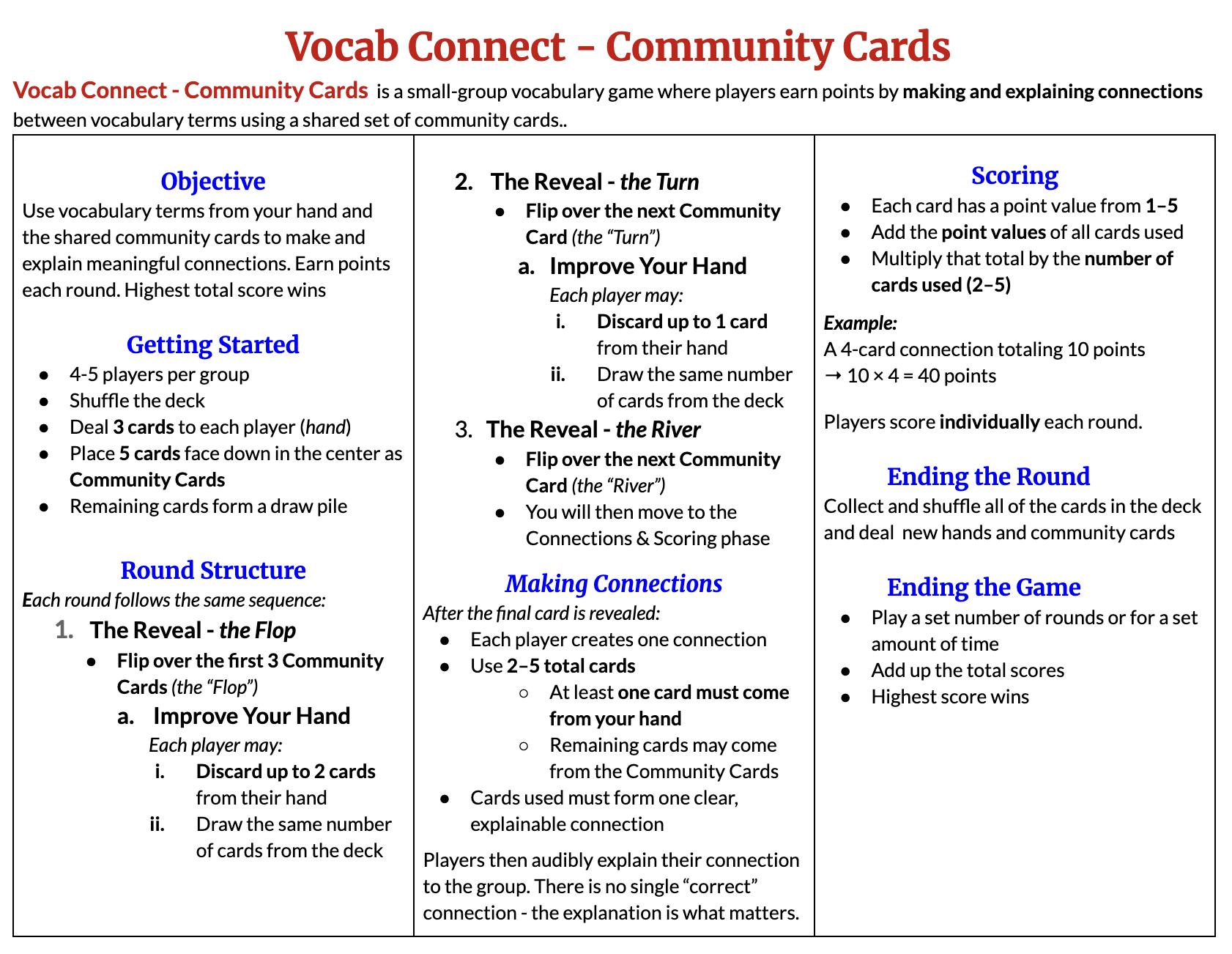
What I like about this idea is that it:
- keeps the shared conversation at the center of the game
- allows for faster, repeatable rounds with some overlapping terms
- It is a vocabulary version of Texas Hold’em


 Michael K. Milton: Musings on History & Education (mostly)
Pingback: Spin, Smash, Repeat: Building a Small Vocabulary Game (Vocab Crusher) | Michael K. Milton: Musings on History & Education (mostly)