Vocab Connect: A Review Game, Made Easier

Back in 2015, I purchased a new copy of Apples to Apples. Prior to teaching when I managed AmeriCorps teams, that was my favorite lunchtime activity. We played these epic games where the competition was fierce. 

But my favorite part wasn’t the winning – it was the table talk. I love table talk.

Making the case that your card fits best. Convincing others. Occasionally downplaying your own card when you were winning too much. Table talk just makes games better!  I was excited to revisit one of my favorite party games.

The social element stuck with me.

In the fall of 2015, I felt like I could breathe again after completing my Masters program. No more constant deadlines. No more coursework for a bit. It was a bit freeing and my mind had space to wander.

It was during this time that I had the idea for a card-based vocabulary game that incorporated the table-talk element of Apples to Apples. I wanted a review game that got students talking about vocabulary – making and defending connections between words. Around the same time, we had just done professional development on tiered vocabulary. This gave me the idea to tier the vocabulary for the game – opting for numbering the cards based upon complexity 1 – 5.

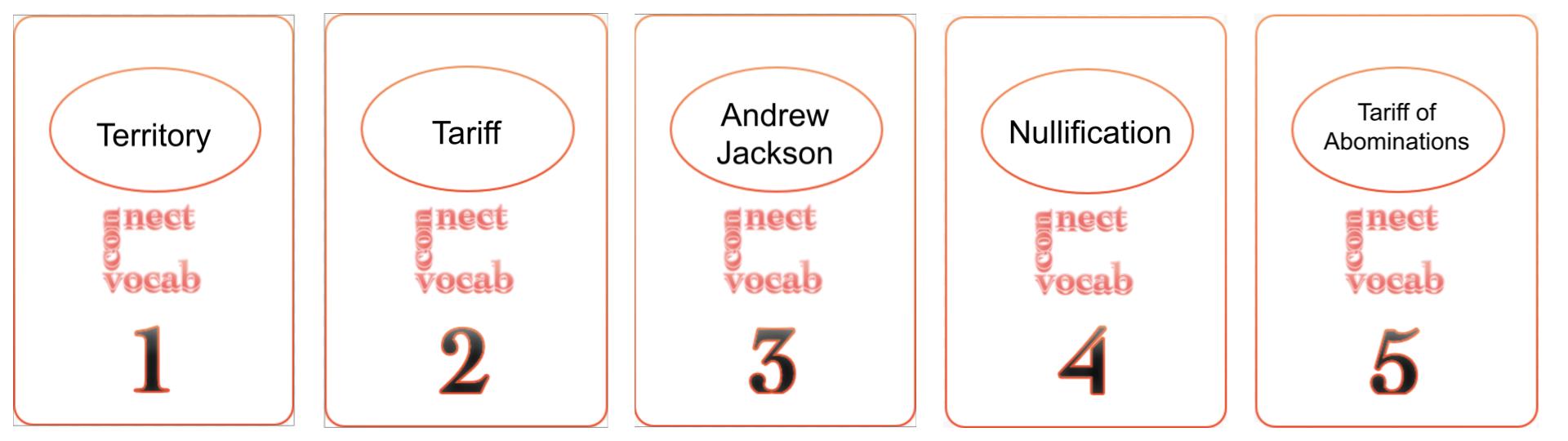
An example of the Vocab Connec Cards.
An example from a unit on Andrew Jackson, the 52-card deck includes vocabulary, people, events, documents, and laws. As Andrew Jackson connects to so many concepts, I used his name as a 3-point card (& included a few of them in the deck).

At its core, the game is a bit of the social element of Apples to Apples mixed with the card game Rummy. After being dealt a hand of cards, students lay down 2-5 cards to start their own connection piles or build onto the piles of their opponents. The bigger and more complex the connection, the more points it’s worth. A connection pile can grow to a maximum of five cards – anything more than that became unwieldy during early playtesting.

Scoring reinforces the same idea: add up the point values of all of the cards in a connection, then multiply that total by the number of cards used. Bigger, more thoughtful connections are rewarded.

But the most important rule has always been this:

You must make your connection audibly.

Every play requires an explanation to the group. Then the next player can build on that connection – or start a new one – but they also have to explain. I’ve found that students who are shaky on certain vocabulary words start to pick them up naturally as they hear classmates use them repeatedly and in context.

Sometimes students ask if they can use their notebooks while playing. Why not? The goal isn’t to stump students; it’s to get them playing with the vocabulary. If checking notes or receiving a well-timed hint keeps the game moving and the language circulating, that’s a feature, not a bug. This is especially true for some of the rarer 5-point words, which can be very specific.

When we play, students will often run through two rounds, and we sometimes highlight particularly high scores at the end. That little bit of recognition adds to the energy, but doesn’t overshadow the real point of the game: sustained, social engagement with academic language. 

Vocab Connect has consistently landed especially well with freshmen. My Juniors have also gotten into it, but freshmen tend to get competitive in the best way. I usually run four to five decks per class, with four to six students per group being the sweet spot (though you technically could probably play with two).

Continue reading
Posted in Uncategorized | Tagged , , , | Leave a comment

From Policy to Practice: Taming Revisions (in My Classroom)

Rain rapped against my classroom windows just enough to make me dread the walk to the car. I had forgotten my umbrella. I did not expect the rain. I also did not expect the day to go like this. It started fine…but by the end I knew that something needed to change. It must have been a Tuesday (I am decidedly not a fan).

This year our school introduced a new revision policy. Students who earned below an 80 percent on a summative assessment and showed evidence of preparation could revise or retake the assessment for a maximum score of 80 percent. There was a reflection form offered by the school for the students to complete and I met with each of them before scheduling a revision. Okay!

On paper, the policy was clear and fair.

In practice, it quietly broke my workflow.

Somehow I had synced my classes perfectly, and on this particular afternoon my room was full of students ready for revisions. I had scheduled them, but my system had evolved into a mess. It started on the backs of the reflection forms. Then it moved to a loose-leaf sheet when I realized flipping through a dozen papers was going to be an issue. Then came the Post-its when students began stopping by at random times to meet with me.

The policy wasn’t the problem.

The meetings were fine. We met. We discussed preparation. We scheduled. But when a classroom full of students arrived at 1:30, I scrambled to get everyone set up. And of course there was one exam hiding in plain sight on a shelf of my brand-new desk organizer, which turned out to be only as good as the person using it. Yes, I’m the problem. It’s me.

When the last student left, I just sat there staring at the stack of papers.

By the time I made my walk to the car that soggy day, I knew that something had to change. I just needed a minute.

Step One: One Small Change

The first change was small.

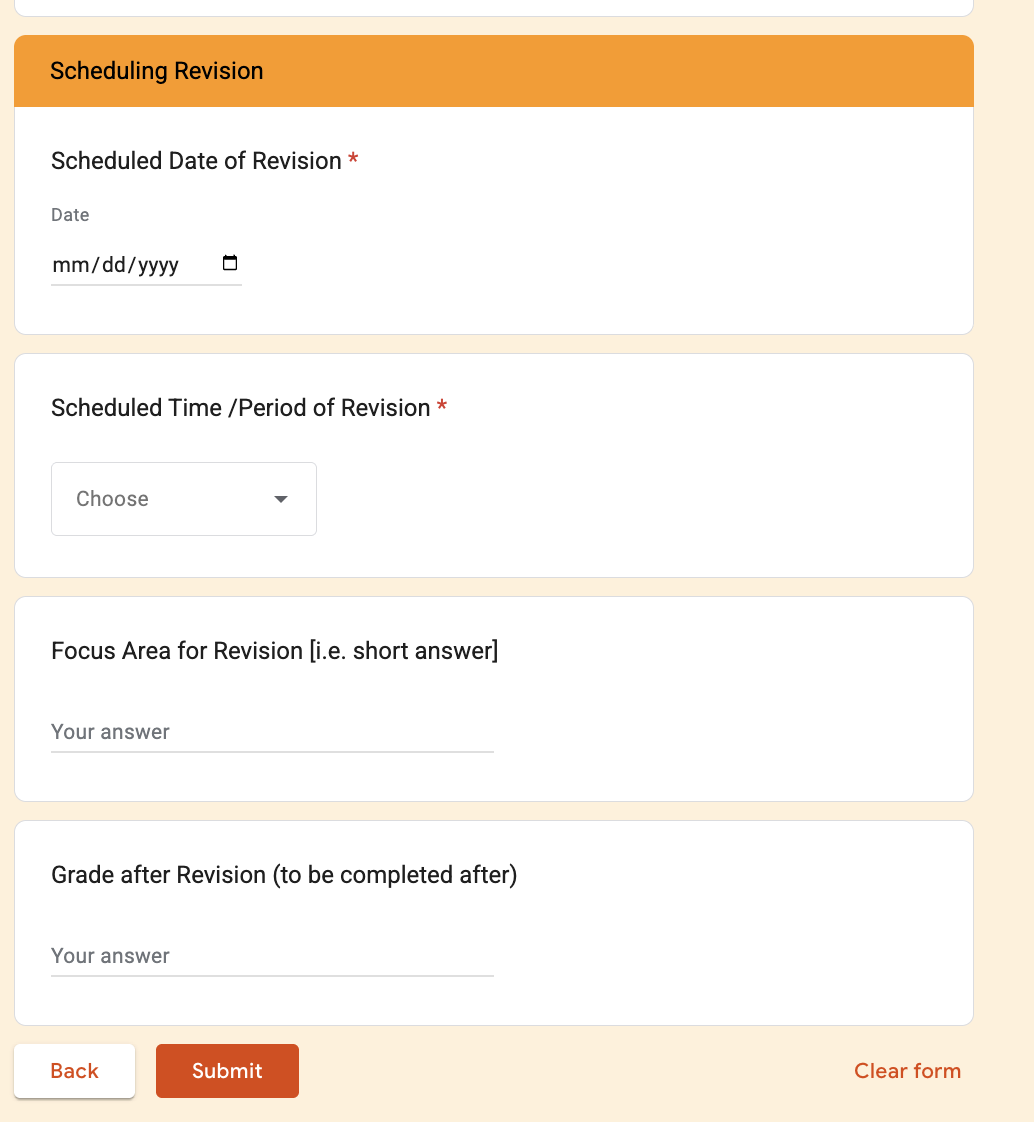
I needed to capture information in one place. I decided that I would complete a Google Form during my meetings with students.

I thought about the vital information that I needed in order to schedule.

  • student name
  • course
  • assessment
  • date of revision
  • time or period of revision

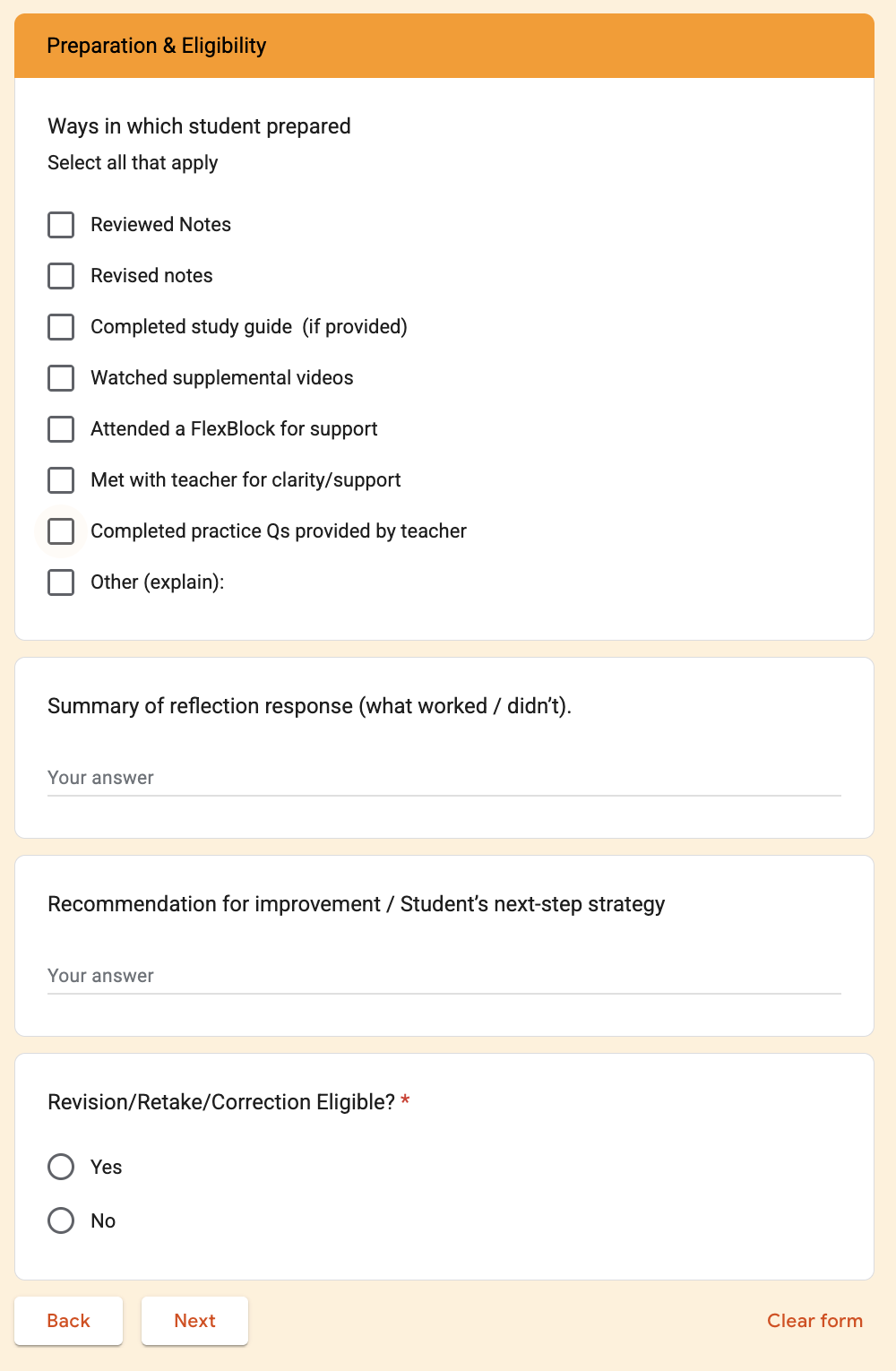
Then I thought about the part of the policy I really liked: the reflection. The reflection form had, I think, seven questions for students to complete before or during the meeting, but many got tripped up by parts of it. So I trimmed it down to what I thought mattered most:

  • How they prepared
  • What worked (or surprised them)
  • What they would try differently next time

I folded those reflection prompts into the same Google Form.

A form labeled '2025-26 Revision Conferences' with fields for student email, period/course selection, last name, first name, assessment title, date of assessment, and grade on assessment.

Now the process was simple: students completed their paper reflection, we met, and I captured everything in the form.

And everything now would live in one place.


Step Two: Making the Spreadsheet Work (for me)

Continue reading
Posted in Uncategorized | Tagged , | Leave a comment

Leveling Up the DBQ:  A Skill-Based Approach to Teaching the AP DBQ

It’s been a minute since I last posted here.

The last time I wrote on this blog was sometime around 2016. A lot has changed since then – in schools, in classrooms, and in how people share their work. I’m not sure blogging is the medium for the moment we’re in anymore.

But I’ve been working on a project I’m very excited about, and I wanted to share it. And maybe writing a blog post like it’s 2014 is exactly the right level of nostalgia I needed. I also enjoy the long form – well, this won’t be long long – more like medium form.

If I talked to the dead and blogged about it, this would be a medium’s medium for medium-sized thoughts.


Wanting to Do Something Different

For the past few years, I’ve been teaching AP World History – a course that covers history from roughly 1200 to the modern-ish day, with a big exam at the end. In addition to content knowledge, students are asked to demonstrate historical thinking skills through a Long Essay Question (LEQ) and a Document-Based Question (DBQ).

The DBQ typically gets introduced during the third unit (November-ish). My usual approach was familiar: introduce the skills, have students practice them in groups, and then collectively look at exemplars released by the College Board. That introduction was already circled in red on my calendar – even though it was still a month away (at least in this retelling; the reality was more of a loose notion of when it should happen). It felt pretty locked in.

One day, before class started, I noticed a student running a science experiment on his computer. He was clicking, testing, watching reactions unfold.

I got a little jealous.

We should have something like that in history.

So I did what any reasonable person would do: I mixed a bunch of fake chemicals together to see what would happen.

Later that night, I kept thinking about it. I started replaying the history games I’d enjoyed over the years. I had joked years earlier about playing Assassin’s Creed Unity (the French Revolution one) in class to teach history. Knowing the history makes that game so much more fun – and some parts a bit easier. My mind drifted…

That’s when my thoughts shifted to one of the biggest set pieces in AP World History: the Document-Based Question, or DBQ. Seven documents. One prompt. An essay built around a rubric made up of discrete skills.

What if that was a game?

And that’s more or less how I stumbled onto the idea.

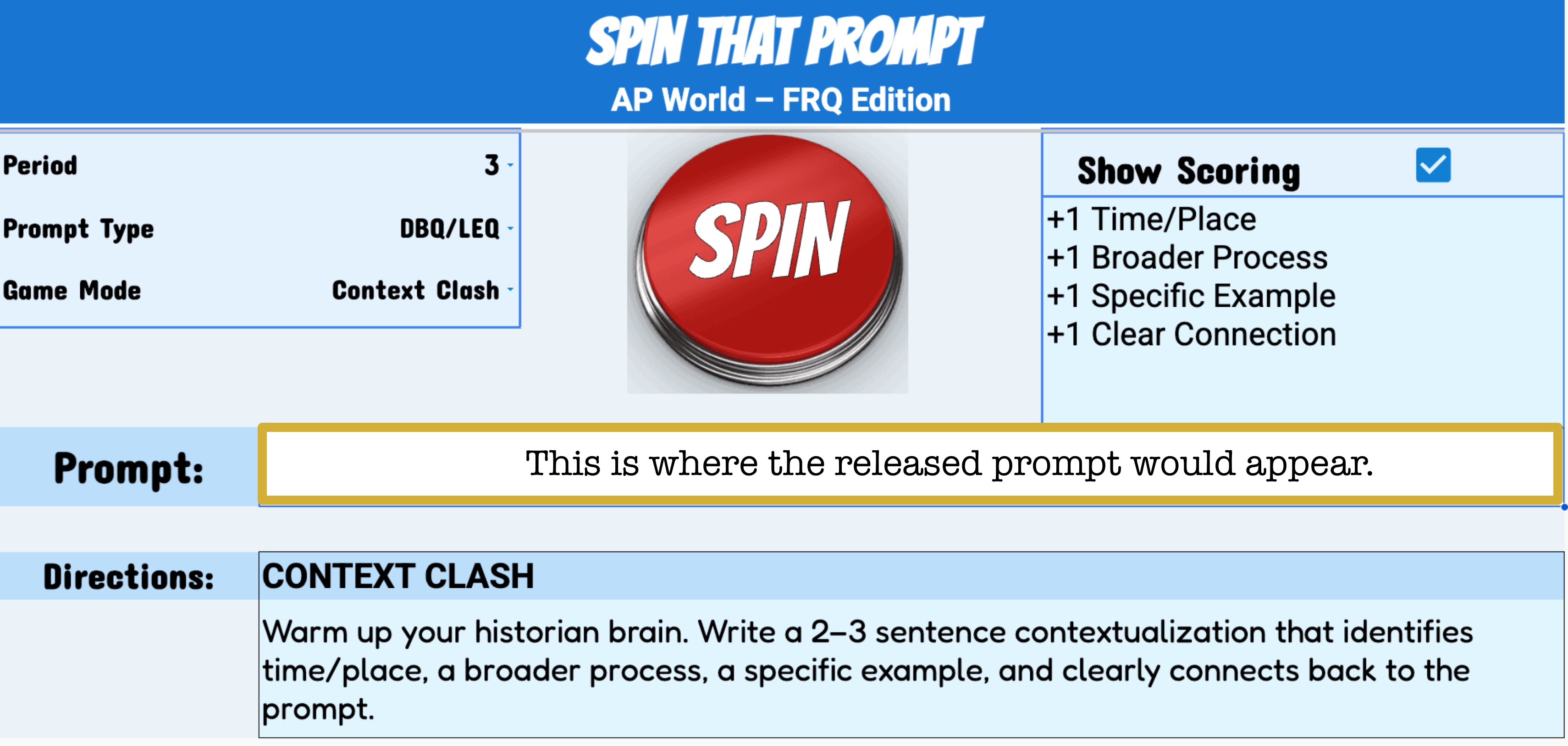
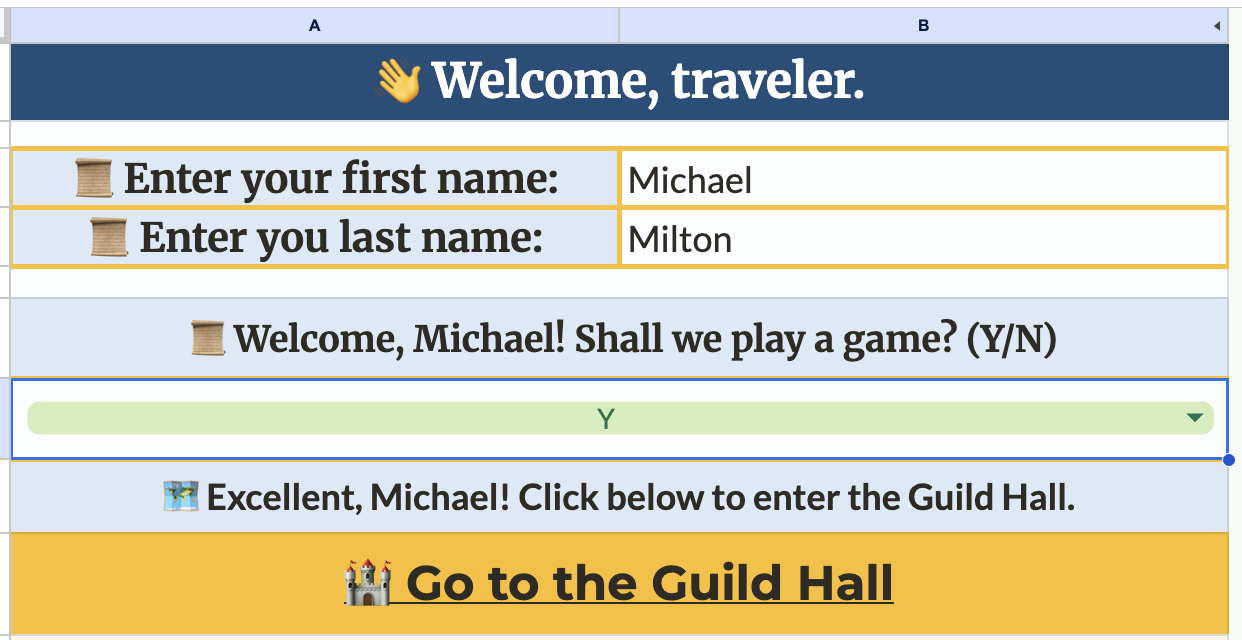
Google Sheets interface displaying a welcome message for users, with fields to enter first and last names, and options to start a game.
Interactive welcome screen for the DBQ Guild: Questline I, featuring a WarGames-inspired introduction.
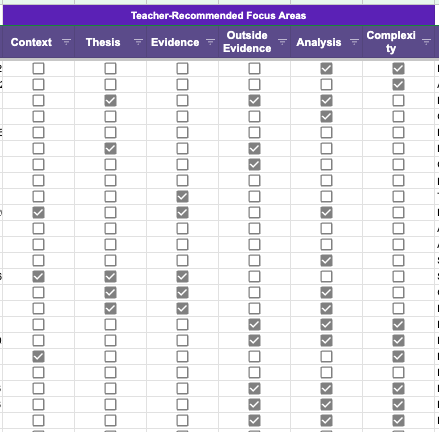
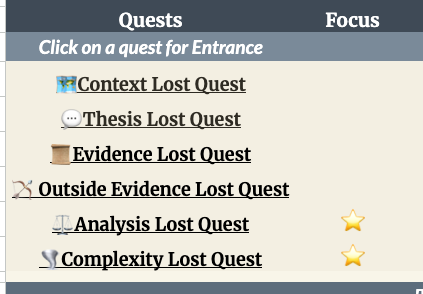
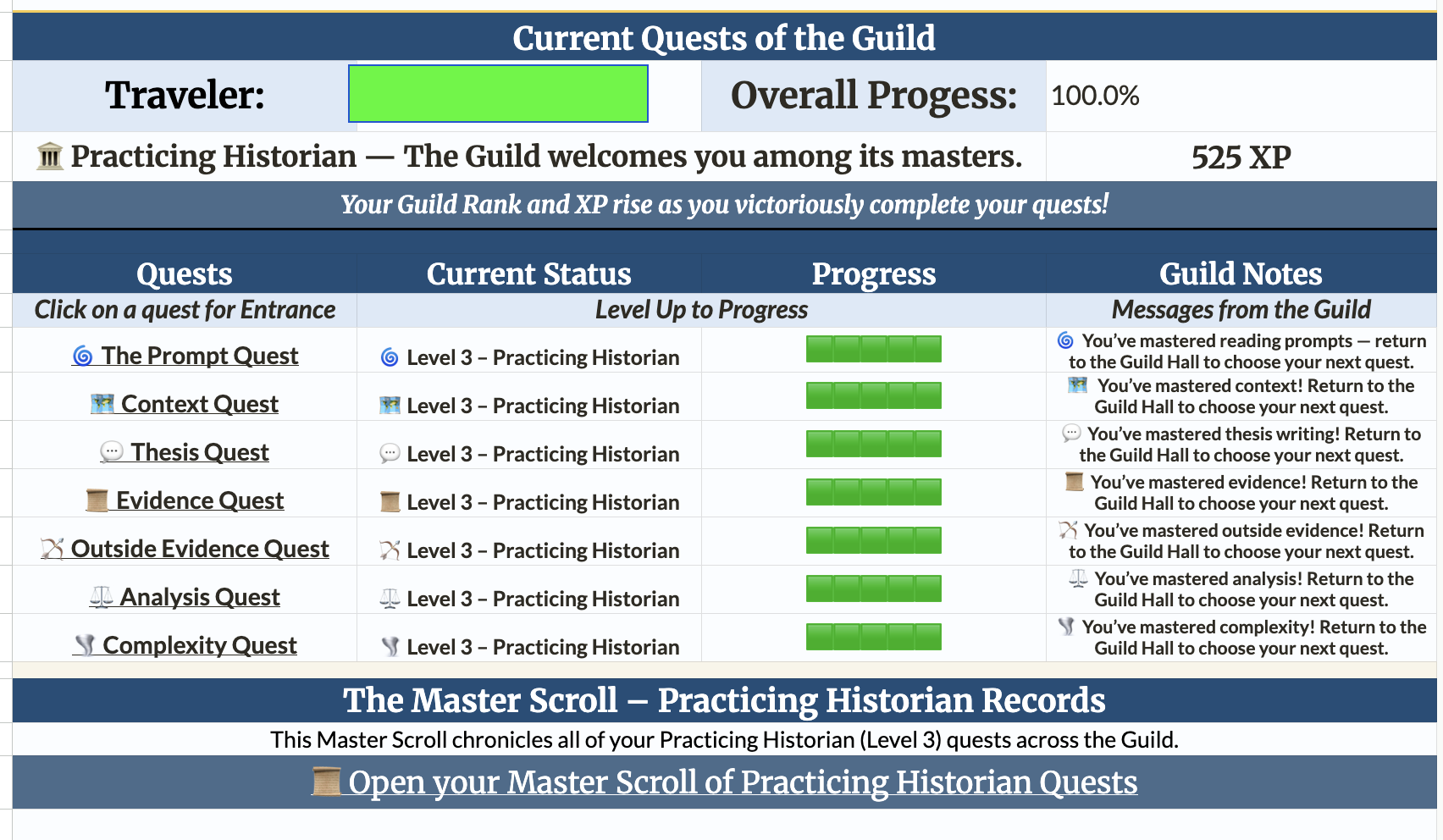
Screenshot of a Google Sheets tracker for an AP World History project, displaying quests, progress, and student messages.
A Google Sheets tracker for managing student progress in the DBQ Guild: Questline I, featuring quests and overall performance metrics.

Why Google Sheets

Continue reading
Posted in History | Tagged , | Leave a comment

Continental Congressional Law & Order: How I Intend to Use the Declaration of Independence (Next Year)

While some may want a time machine to witness seminal moments in history, I just want to go back a month ago. It was a simpler time back then, a younger Michael Milton went to begin teaching a unit that would lead his class to the American War for Independence. And I want very much to travel back to stop him.

It’s not that my unit went off track.

I’m proud of the fact that I added in a lesson that discussed ways in which enslaved workers protested – which included looking at the Dunmore Proclamation where enslaved workers in Virginia could fight with the British military in exchange for their freedom (which is referenced in the last of the grievances listed in the Declaration of Independence).

It’s that I think I know how to make the unit better.

And in doing so, I would make one of the most important pieces of our history as the centerpiece.

I figured it out while preparing and updating  an activity for my World History class. For this class, my students are looking at the French Declaration of the Rights of Man and of Citizen to decide which of the sacred rights of man that Robespierre violated during his Reign of Terror. I call it, “Law & Order: French Revolution.” [Here is a link to the piece that I wrote about this a few years ago.] Continue reading

Posted in Uncategorized | Leave a comment

History Investigations: Voices from the Past

As I have begun to mentor an aspiring educator, I’ve been thinking about my various roles as a teacher. At any given moment I am a mentor, a guide, a sources of knowledge, a hero, a villain, a supporting player, a taskmaster, and a cheerleader. I am an ever-shifting presence in the lives of my students until I become a memory.

In addition to my metaphorical hats, I also have many physical hats that I don to embody different historical characters. I play Napoleon, Charles Knight (author of The Working-Man’s Companion), Otto von Bismarck, and a variety of generic roles from different periods of history. I often find myself on Amazon thinking, “seriously, how have I lived 35 years without owning a Victorian era top hat?” As a teacher, you try many ways to make learning more engaging and the smattering of characters is simply one of those ways.

Over the past few years, I have been trying to create opportunities for my students to interact with history. Sometimes ideas for this hit you at the oddest moments. One snowy day during winter break, I was myself watching one of the Mission: Impossible movies when I heard…

“Your mission, should you choose to accept it is to…”

My mind began racing…

Could I use this as an assignment set up in the classroom? 

The idea delighted me as I imagined myself sending self-destructive assignments to my students.

What if it wasn’t me who assigned the students a project but a rather a voice from the past?

This led me to, over a year or so, develop several Voice from the Past assignments. I am sharing three in this post that while are formatted differently and use varying levels of technology, they all have a similar set up. One is about the Lewis and Clark Expedition, one of an investigation into the assassination of Franz Ferdinand, and the final is a look at the origin of the Mexican War.  Continue reading

Posted in History | Tagged , , , , , , , , | 2 Comments

Preparing for Exams like a Conspiracy Theorist

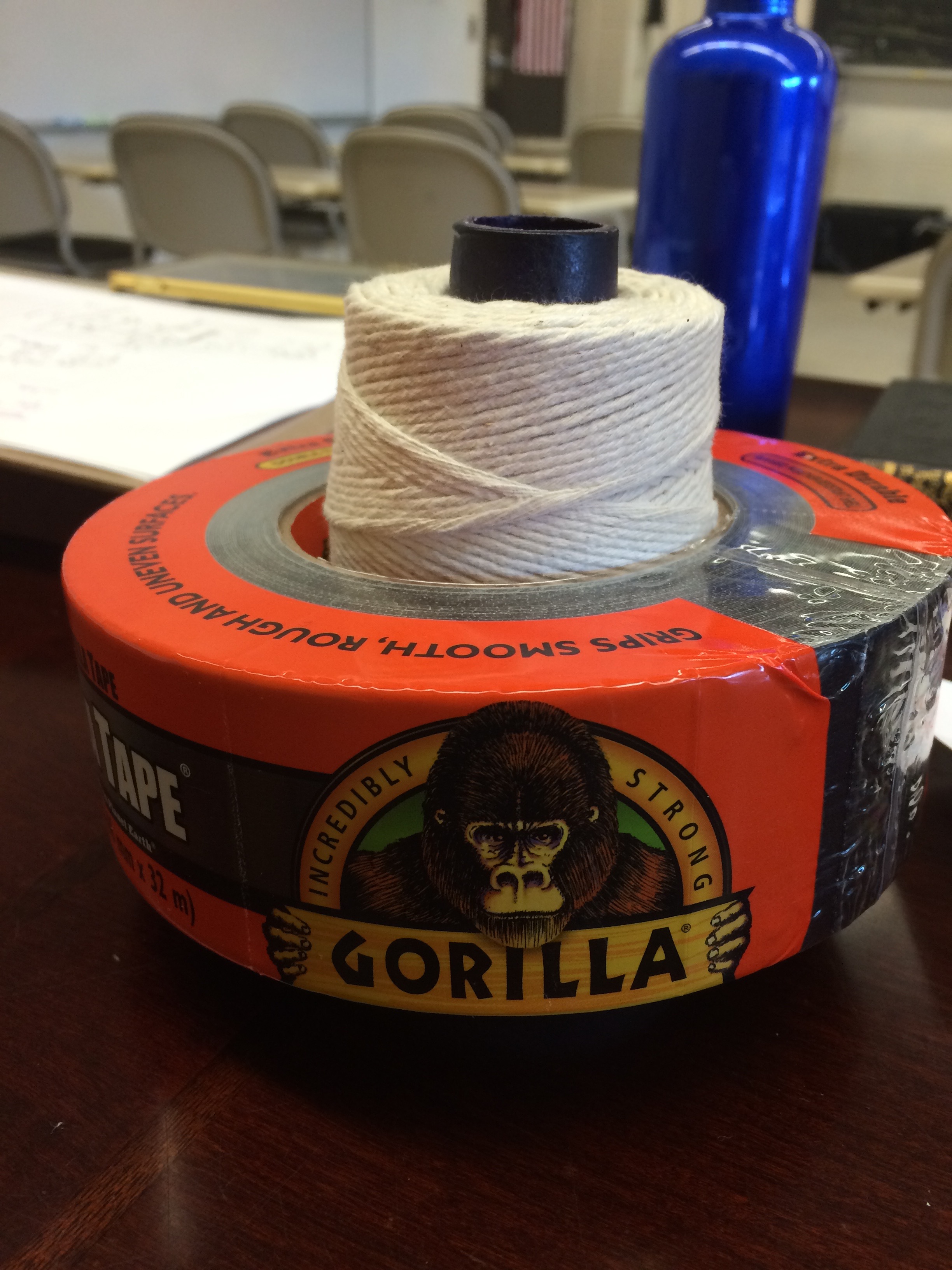
My favorite tools to prepare students for midterms is not an app or notecards (although both can absolutely be useful) but rather kitchen twine and Gorilla tape.

IMG_0013.jpg

A few summers ago, I read Making Thinking Visible: How to promote Engagement, Understanding, and Independence for All Leaders which, I feel, leveled me up as a teacher. The crux of the book is that to help students develop their as critical thinkers, we must name and explain the types of thinking routines. [I can lend out my copy, but I have written all over it and as I reference it regularly I’d need it back.]

Continue reading

Posted in Uncategorized | Tagged , , , | 2 Comments

Hamilton vs. Jefferson: Using Hamilton the Musical in the Classroom | Discovery Education

Below is the start to my post for Discovery Education about using Hamilton the Musical in the classroom! Check it out!
_____________________________________________________________________

“And the world’s gonna know your name –
What’s your name, man?

Alexander Hamilton.
My name is Alexander Hamilton.
There’s a million things I haven’t done
But just you wait. Just you wait…”

For the past four years, I have used Lin-Manual Miranda’s performance at the 2009 White House Poetry Jam to introduce my students to Alexander Hamilton. And every year, they demand a second viewing. Lin-Manual’s ability to tell Hamilton’s story through hip-hop is absolutely amazing and my students often sang the song weeks later.

Lin-Manual Miranda is the genius behind Hamilton the Musical, the hit musical that tells the story of the first treasury secretary and of our young nation. When tickets for the production went on sale I immediately bought them. I cannot explain how amazing the show is. Mr. Miranda not only does a remarkable job bringing Alexander Hamilton to life, he breathes life into the founding of our nation. After seeing it, I could not wait to bring it to my class.

While Act 1 does an amazing job focusing on Hamilton’s experience during the War of Independence, as a classroom teacher it is the second act that I feel could help illuminate the differences between the Jeffersonians (Democratic-Republicans) and the Hamiltonians (Federalists). Two of the songs in particular, “Cabinet Battle #1” and “Cabinet Battle #2” directly highlight the foundational differences between the beliefs of Alexander Hamilton and Thomas Jefferson.

For this lesson, I am going to focus on “Cabinet Battle #1” which focuses on core economic differences between the two secretaries. In this rap battle, President Washington mediates a discussion regarding Hamilton’s economic plan. The lyrics are fast and full of history! As my students would be overwhelmed with this at first, I need to back up and discuss the differences between the two men.

Source: Hamilton vs. Jefferson: Using Hamilton the Musical in the Classroom | Discovery Education

Posted in Uncategorized | Leave a comment

Shining a Light on the Unknown: Helping Students Understand ISIS and the Syrian Civil War | Discovery Education

My new post for Discovery Education!

As a fifth grader during the Gulf War, I distinctly remember Mrs. Spina helping to calm our fears about the war. After giving us a background on the war, Mrs. Spina brought us to a large world map to show us how far away the fighting was from our small town in Massachusetts. I remember going home and feeling more confidant talking about the war with my parents. While I did not fully understand the entire situation, I understood the war a bit better. When I started to watch the news on my own that background proved invaluable as I could follow along with the news anchor.

While we all have metrics and curricula to get through, as teachers we must help our students understand the world around them. The unknown is scary. As teachers, we help shine a flashlight on the unknown. We empower students through knowledge.

When ISIS attacked Paris on Friday evening, I knew that whatever lesson I had originally planned for Monday was out the window. I spent much of the weekend reading about the attacks, about ISIS, about the Syrian Civil War, and about the refugee crisis. I thought about the lesson from Mrs. Spina and while I could not show them a map about fighting far away to assuage their fears, I could help them understand more about what is going on in Syria.

When class began on Monday, my students were very concerned. We began just talking about the bombing in general – both in Paris and Beirut. Listening to them and their concerns helped guide the next few days as I sought out resources to use with them.

With this post, I am going to share resources that I have gathered and my final activity for discussing American involvement in the Syrian Civil War.

For more, click on the link!

Source: Shining a Light on the Unknown: Helping Students Understand ISIS and the Syrian Civil War | Discovery Education

Posted in History | Leave a comment

Historical Digitally Altered Image Project

As many of you have might have seen on my website, I have been digitally altering movie posters and other images to tell a new historical story. The results are often silly but have been a fun outlet for me personally.

How George Got His Groove Back

How George Got His Groove Back (and the original poster prior to my alteration)

For instance, How George Got His Groove Back popped into my head after researching and then visiting Washington’s Crossing. I simply had to make this when I got back to my hotel that night!

This summer my friend, occasional writing partner, and one of my #sschat co-moderators Dan Krutka suggested bringing my students in on the fun. Together, we created the framework for an inventive project in which students altered images based upon what we cover in class to demonstrate their understanding and to eventually serve as review material. Continue reading

Posted in History | Tagged , , | 2 Comments

Honoring Our Veterans: Using Inquiry to Discuss Veterans Day | Discovery Education

I’ve recently begun blogging for Discovery Education! My first assignment was to create a lesson for Veterans Day and I am really excited to share this with you!

_________________________________________________________________________________

“My name is Michael K. Milton, and I am a US and World History teacher at Burlington High School in Massachusetts. My classroom is a place where my students and I get to experiment! As students explore history, they reflect, draw connections, inquire, discuss, debate, and seek out more knowledge about the world in which they live. Like my students, I love to learn, question, debate and inquire with my peers. In this, my first blog entry for Discovery Education, I want to share what Veterans Day means to me, and how I incorporate meaningful reflection into my classroom.

Inquiry-Based Lesson

In addition to honoring the past, I want students to grapple with how our society has treated returning soldiers historically, and how we treat them today. For an initial lesson, I might focus on the time period following World War II and compare it to how soldiers are treated today. My big question is, are we honoring our returning troops? Creating an inquiry-based lesson in which students are asked to evaluate historical circumstances allows them to research, discuss, debate, evaluate, and ultimately formulate a position and support it with evidence.”

For the complete article, visit the below link!

Source: Honoring Our Veterans: Using Inquiry to Discuss Veterans Day | Discovery Education

Posted in History | Tagged , , | Leave a comment