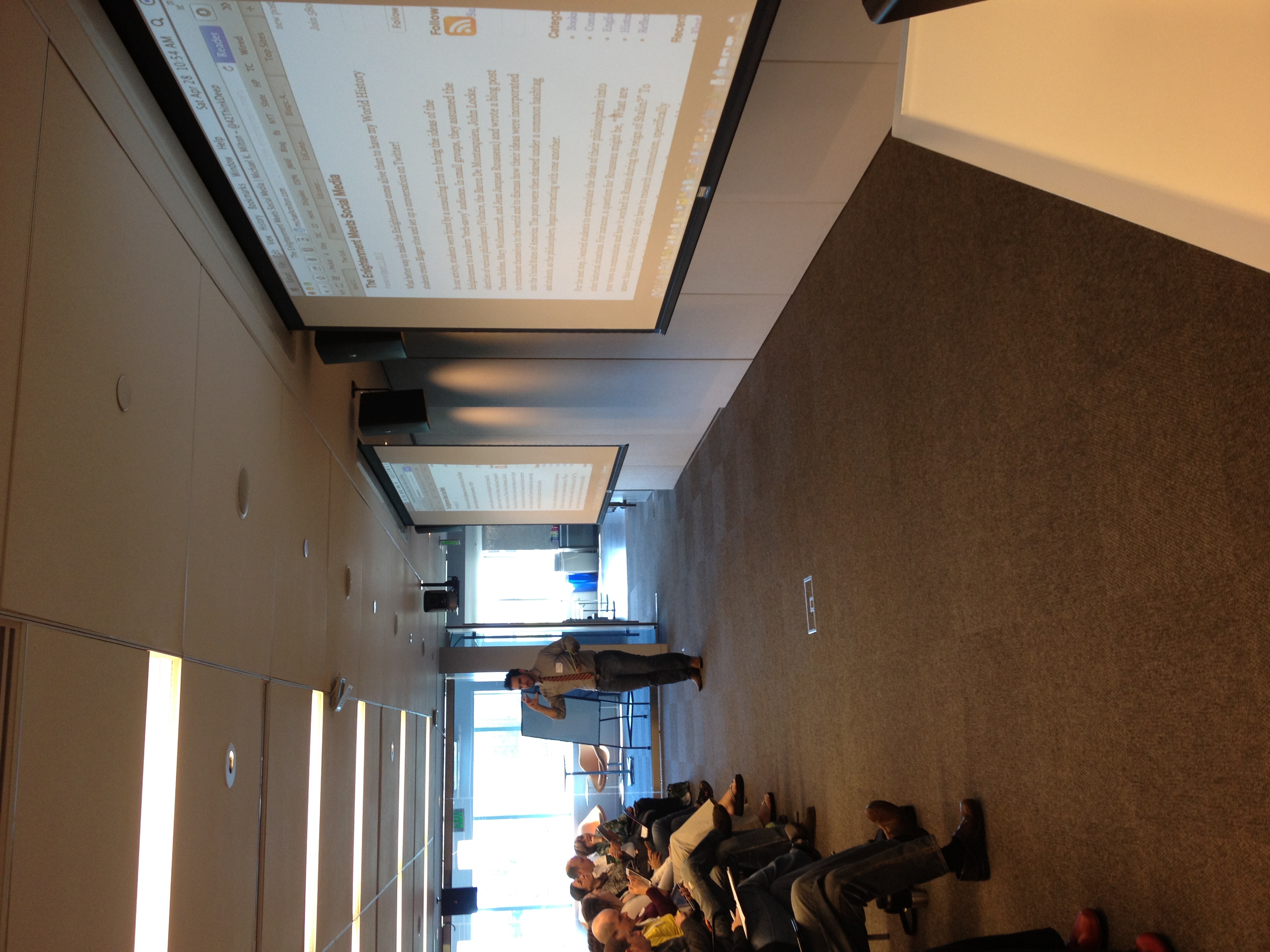
On Saturday, Andy Marcinek and I led a discussion on the use of Social Media in the Classroom at EdCamp Boston. Andy masterfully worked the room giving reasons and examples as to why social media should be utilized in class (meet students where they are at, create an active classroom, develop a class and school community) and I contributed examples of how we integrate social media in the classroom at Burlington High School (also, I told an epic joke about a buffalos). Leading this was (for me) a thrilling way to have a discussion about the benefits (and possible distraction) of using Twitter, Blogger, and Youtube in the classroom.
Last week, I was greeted early one morning with the news that I was influential on Parenting. Klout sent an e-mail to congratulate me on this impressive accomplishment. I felt a bit caught off-guard to handle the news for two reasons. First, I have never tweeted nor written anything about parenting. Second, I am not nor have I ever been a parent. As I imagine in order to be influential on parenting those two things are important, I was very confused as to why, exactly, Klout has bestowed upon me this honor. This thought process led me from bewilderment, to mild annoyance, to acceptance, and, finally, to empowerment~or as I will call them The Four Stages of Unwarranted +K-ing.
(For those unfamiliar with Klout, it is an online tool that measures your influence on social media platforms. It also indicates topics that you have a degree of influence in the conversation.)
After researching close reading strategies for a lesson that I want to do sometime in the next few weeks, I had an epiphany of sorts while running past my eye doctor’s office. Last fall, I spent hours upon hours waiting in her office (my eyes were rejecting contacts) and I came across this book..a haunting reminder of my youth. Yes, my early teen years were partially plagued by Magic Eye: A New Way of Looking at the World (and numerous other iterations).
To get the full effect, I recommend clicking on this image* to attempt to unearth the hidden image, which is cleverly hidden behind the repeating pattern. If you have never seen this type of image and want step-by-step instructions, click here.
This was one of my favorite activities to design – to demonstrate their understanding of nationalism, my students created a tri-fold travel brochure for Italy, Germany, Haiti, or Mexico (we had just discussed how these nations became free/unified). For the assignment, students were working for a Department of Tourism in one of the above nations and needed to ramp up tourism for the nation. To accomplish this, they had to create a travel brochure that highlighted the nations origins as well as provide information about the country today.
It is the end of your lesson on the the five motives behind imperialism. The students have analyzed different primary documents that demonstrated at least one of the five motives – Economic, Ideological, Exploratory, Religious, and Political. You want to create a homework assignment that will reinforce the vocabulary that your freshman (or sophomores) have learned. You want to do something a bit different than normal that will reinforce the five motives to your students in an engaging way. Driven by the desire to also share with your students your love for the original STAR WARS trilogy and your district’s goal to align with the common core, you decide to have your students embark on a journey that will simply take the night….
One of my goals for this upcoming year is to create a project-based learning (PBL) unit for my World History class. In order to wrap my head around this concept I have been lurking in different Twitter chats and reading articles about PBL. Still, the concept seemed foreign to me. It wasn’t until I was running this morning and my mind was a million miles away (an estimate only) thinking about the new Muppet movie that things began to connect.
The Muppets is actually a movie designed around PBL!
The Muppets were given a project – to save Muppet Studios from its impending destruction. They had to work both cooperatively and independently to accomplish this. Just like my students bring different talents to the table, so do the Muppets. Like Walter (a new character introduced in the film), my students need to develop skills in order to be successful.
What started off as an exercise to prepare for a department meeting has now become a bit of a hobby. For the past few weeks, I have been reflecting upon my past lessons and adapting them to the Common Core Standards for History/Social Studies. I feel that I have learned a great deal along the way and have enjoyed the dialogue that has stemmed from this activity.
This week, I wanted my students to analyze a primary document, identify the central idea, and then communicate that to their peers. For this activity, students were given one of four primary documents and were directed to write a news article that would appear to have been written during the Great War (World War I) to bring awareness to the public. Upon completion, they joined a group of students who covered different primary documents and together they assembled a newspaper.
While this activity occurred in the context of World War I, the model can be used in any time period (while still addressing the below standards).
This activity addresses the below standards:
RH.11-12.2. Determine the central ideas or information of a primary or secondary source; provide an accurate summary that makes clear the relationships among the key details and ideas.
WHST.11-12.4. Produce clear and coherent writing in which the development, organization, and style are appropriate to task, purpose, and audience.
What we did:
Students were split into four groups to read and annotate one of the four documents relating to World War I. By doing this together were able to help each other to better understand the document.
Individually each student wrote a newspaper article to explain to the World War I era audience what was going on at the warfront. If they had a war poem or a literary excerpt, they took on the role of literary critic with the goal of writing what that piece of literature said about the war experience. To accomplish this, students had to properly integrate two quotations into their news article. They also had to find an image to go along with their work (picture, graph, drawing, etc…).
In a “jigsaw” group, students put together a newspaper and discussed the four articles.
Admittedly, my students’ initial reaction to this assignment in one class was less than thrilled. One student said, “Mr. Milton, this isn’t an English class.” I stopped to explain the purpose behind the assignment – the ability to identify the main point of the primary document and then summarize the piece is an important skill for them to develop. Furthermore, writing is not just something that they should be doing in English class, but something they should be constantly be improving upon because they will be doing it for the rest of their lives. I am actually glad that I took the time to explain the reasoning behind this assignment because it helped them understand the purpose of the assignment (and there was no more complaining).
Like many of my static projects, the biggest issue is sharing the newspapers with the entire class so they can see the different interpretations of the same primary documents. Having them posted around my classroom is one thing, but having them in a space that they can share outside of school is my goal. I have heard about classes that have done amazing things with Glogster – but it doesn’t play with the iPad. I do enjoy student-created blogs, but for one-off assignments, it doesn’t make as much sense. If anyone has an idea, I’d love to hear it. I think it was Nathan Hale* who said, “My only regret is that I did not find a way to share my students’ work online.” Truly he was a man ahead of his time.
*That, like many others that I have use on this blog, is a made up quote. Please do not cite it in a serious way.
Last week, I posted about teachers having Teacher Trading Cards as a means to connect with students, parents, colleagues, and learning networks. Also, collecting them all could become a great new pastime. Many people have contacted me for a template to create their own. Well, look no further! Here it is!
I have always been an advocate for time travel in the classroom. Imagine learning about the Constitutional Convention by actually going there? Or becoming involved in a discussion about human nature with John Locke? I fully realize that by doing this, my class may inadvertently change history rendering our future obsolete (which is why I haven’t asked for the funding of a time machine). But the idea of time travel still fascinates me.
Over the past few weeks, I have been doing a lot of thinking about the Common Core for History/Social Studies Standards as my department has been linking our lessons to them. So, when I entered into a discussion about Bill and Ted’s Excellent Adventure this weekend, my mind almost immediately went to this.
For those unfamiliar with B&TEA, watch the trailer below:
The movie begins with Bill and Ted being given a history project that they must present in order to graduate. The project itself is a cumulative look back at what students learned in their World History class. The prompt for this project is as follows:
“Express to the class how an important historical figure from each of your time periods would view the world of San Dimas, 1988.”
This inspired activity addresses the following:
RH.11-12.9. Integrate information from diverse sources, both primary and secondary, into a coherent understanding of an idea or event, noting discrepancies among sources.
WHST.11-12.7. Conduct short as well as more sustained research projects to answer a question (including a self-generated question) or solve a problem; narrow or broaden the inquiry when appropriate; synthesize multiple sources on the subject, demonstrating understanding of the subject under investigation.
While Bill and Ted had the luxury of a time machine, his classmates had to research time periods in history, identify important figures in those time periods, and hypothesize what the historical figures would think about the current society. Mr. Ryan (their teacher, thanks IMDB!) clearly understood how to create an effective project that went beyond the norm and requires his students to reflect upon their society.
If I were to do this assignment (any of my students reading this ~ be prepared to get excited!), I would have students create some sort of multimedia presentation to present to the class (and outside guests), defend their reasoning for their decisions, and then update the artifact based upon the feedback given.
This would address the following standard:
WHST.11-12.6. Use technology, including the Internet, to produce, publish, and update individual or shared writing products in response to ongoing feedback, including new arguments or information.
One of my students was frustrated today with a question on an open notebook quiz she was taking. The problem was that the answer was not in her notes (she is great about taking thorough notes). We are studying the start of World War I and the question was “How could a dispute between the Triple Alliance and the Triple Entente draw all of Europe into a conflict?” She was hesitant to answer the question. For the sake of this reflection, her name is Dorothy.
Dorothy wanted an answer from the authority, which, in this case, was our textbook. When she found that the answer was not there, she set out on an adventure to find the answer.
Along the way, she met another student on a similar journey. She met Scarecrow out in the hall. He was having an issue on a science lab. He was not sure if his data was accurate. While he had done the lab, he believed that there must be something wrong! How could he be expected to do it right! He was just a student.
To move this story along, the two of them met up with the Cowardly Lion and the Tin Man. The Cowardly Lion was afraid to present to his class so he took an extended bathroom break and, let’s say The Tin Man was hesitant to complete a community service project because he did not think he could connect with the elderly who he had to play bingo with.
The four of them ended back up to my classroom in search for answers – an easy fix to their problems. I was the Wizard, you know. I know all.
Except that I don’t. The truth is, while I occasionally attempt to be the all-powerful Wizard of Oz, I am not. And I shouldn’t be.
My role is not to give the answers but to show students how they can find them. I’m the man behind the curtain – just this guy, ya know.
So I sat with Dorothy and we talked about what alliances are comparing them to her friends and what would happen if her friend got into a fight with another “clique.” Her eyes widened when she understood the situation and she answered the question on her own.
In the end, I am sure Dorothy will have more questions – but I hope that she trusts herself to realize that she is capable is deeper thinking. Because she really did have the power all along.
As for the Tin Man, Cowardly Lion, and the Scarecrow – I trust that my colleagues are working with them to get over their fears and they begin to build skills that will make them successful in their pursuits.