What better way to make the Enlightenment come alive than to have my World History students create Blogger sites and set up a conversation on Twitter!
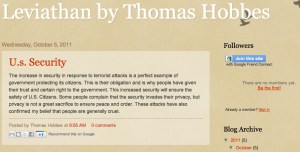
In our activity, students were hired by a consulting firm to bring the ideas of the Enlightenment to a modern “tech-savvy” audience. In small groups, they assumed the identities of various philosophers (Voltaire, the Baron De Montesquieu, John Locke, Thomas Hobbes, Mary Wollstonecraft, and Jean Jacques Rousseau) and wrote a blog post to reintroduce themselves to the world and to discuss how their ideas were incorporated into the United States of America. The posts were then shared under a common hashtag and students, as the philosophers, began interacting with one another.
For the next step, I wanted students to extrapolate the ideas of their philosophers into other historical situations. For instance, a question for Rousseau might be, “What are your views on communism and how it worked in Russia during the reign of Stalin?” To answer this question, students not only have to research communism, specifically communism under Stalin, but they also have to figure out how Rousseau would view both. Now, I could have simply asked the questions myself, but I felt that my students would get more excited to do this research if they were answering to a larger audience. I shared this assignment with my colleagues and my PLN (who then shared it with their PLN’s).
My students really got into the activity, particularly when they realized that they were playing for a larger audience. For 83 minutes (a long block) my students were in research and publication mode. Engaging with those outside of the classroom, as well as each other. I played the role of the facilitator ensuring that all students were engaged.
Overall, my students were able to form a deeper understanding of the philosophers of the Enlightenment and were introduced to both Twitter and Blogger.
Lesson Plan
Objectives
Students will be able to:
- articulate the ideas of Enlightenment philosophers and reflect upon their modern day relevance
- conduct targeted research to answer questions about modern society
- extrapolate the ideas of philosophers into other modern situations
Common Core State Standards
- CCSS.ELA-Literacy.RH.11-12.7 Integrate and evaluate multiple sources of information presented in diverse formats and media (e.g., visually, quantitatively, as well as in words) in order to address a question or solve a problem.
- CCSS.ELA-Literacy.WHST.11-12.4 Produce clear and coherent writing in which the development, organization, and style are appropriate to task, purpose, and audience.
- CCSS.ELA-Literacy.WHST.11-12.6 Use technology, including the Internet, to produce, publish, and update individual or shared writing products in response to ongoing feedback, including new arguments or information.
- CCSS.ELA-Literacy.WHST.11-12.7 Conduct short as well as more sustained research projects to answer a question (including a self-generated question) or solve a problem; narrow or broaden the inquiry when appropriate; synthesize multiple sources on the subject, demonstrating understanding of the subject under investigation.
- CCSS.ELA-Literacy.WHST.11-12.9 Draw evidence from informational texts to support analysis, reflection, and research.
Instructional Materials and Resources
- iPad/Computer
- Primary Documents
- Blogger/Blogging Site
- Twitter
Instructional activities and tasks
Setup
“You have been recently been hired by a consultant firm to bring the ideas of the Enlightenment to reach the modern “tech savvy” audience of the 21st century. While this is a rather large job, you have been put on a team to complete this task. Your job is to create a blog for a specific Enlightenment thinker and enter into a discussion via Blogger and Twitter with other Enlightenment thinkers educate the public on the views of the Enlightenment. While this technological aspect may be new or seem daunting, you will not be alone ~ you will be guided by Mr Milton throughout the process.”
Part I: The Initial Blog Post and Twitter After familiarizing yourself with Twitter and Blogger, you are first tasked with creating an initial blog post written from the perspective of your philosopher. First start with some background – where you are from, when you lived, major works that you have composed, and notable life events. Then outline your beliefs and how they came to be. Finally, write about how your views have impacted the modern world. Make sure to provide sources for all of your information!
Your group will also be required to create a Twitter account for the Enlightenment Thinker. Please personalize it. Send out some introductory posts using our #MrMHWH hashtag! Tell everyone who you are and how you feel about the world today.
Once this is complete, share your blog post on Twitter using the hashtag #MrMHWH. This should be posted by the end of the first day.
Part II: The Discussion Go ahead and read the profiles of the other Enlightenment thinkers. Agree with someone, respond to their post! Disagree with someone, do the same. You should respond to at least three posts.
Now we are going to expand the walls a bit! You will begin to field questions from other teachers and historians not only from our school, but around the US (and potentially the world). People will ask you specific questions about how your philosopher would feel about recent world events. For instance, Voltaire may be asked about hate speech, or Rousseau may be asked about Communism under Stalin. To answer these questions, you must do research on the questions premise (and learn more about your Enlightenment thinker. After a question is asked (via the Twitter hashtag #MrMHWH) you will write a response on your blog (sharing your post via Twitter). Each group will respond to at least two questions. You will then read and respond to the other philosophers at least two of the other philosophers (either as a response on their blog or directly through Twitter). As this is an intensive activity, we may spend a few classes in this discussion.
Part III: The Reflection Following this discussion, you will write a one page reflection discussing what you have learned about your Enlightenment thinker, the other “participants”, as well as how their ideas are or are not present today.
Assessment
15 Points – Initial Blog Post (the post should be free of spelling/punctuation errors and address the prompts fully and clearly)
25 Points – The Discussion (posts and response tweets should be well thought out and accurately reflect the ideals of your Enlightenment thinker. You are required to use at least two sources per question answered.)
10 Points – The Reflection (should be free of spelling/punctuation errors and address the prompts fully and clearly).
50 Points – Total
This post can also be found on http://bhsplp.wordpress.com/.







 Michael K. Milton: Musings on History & Education (mostly)